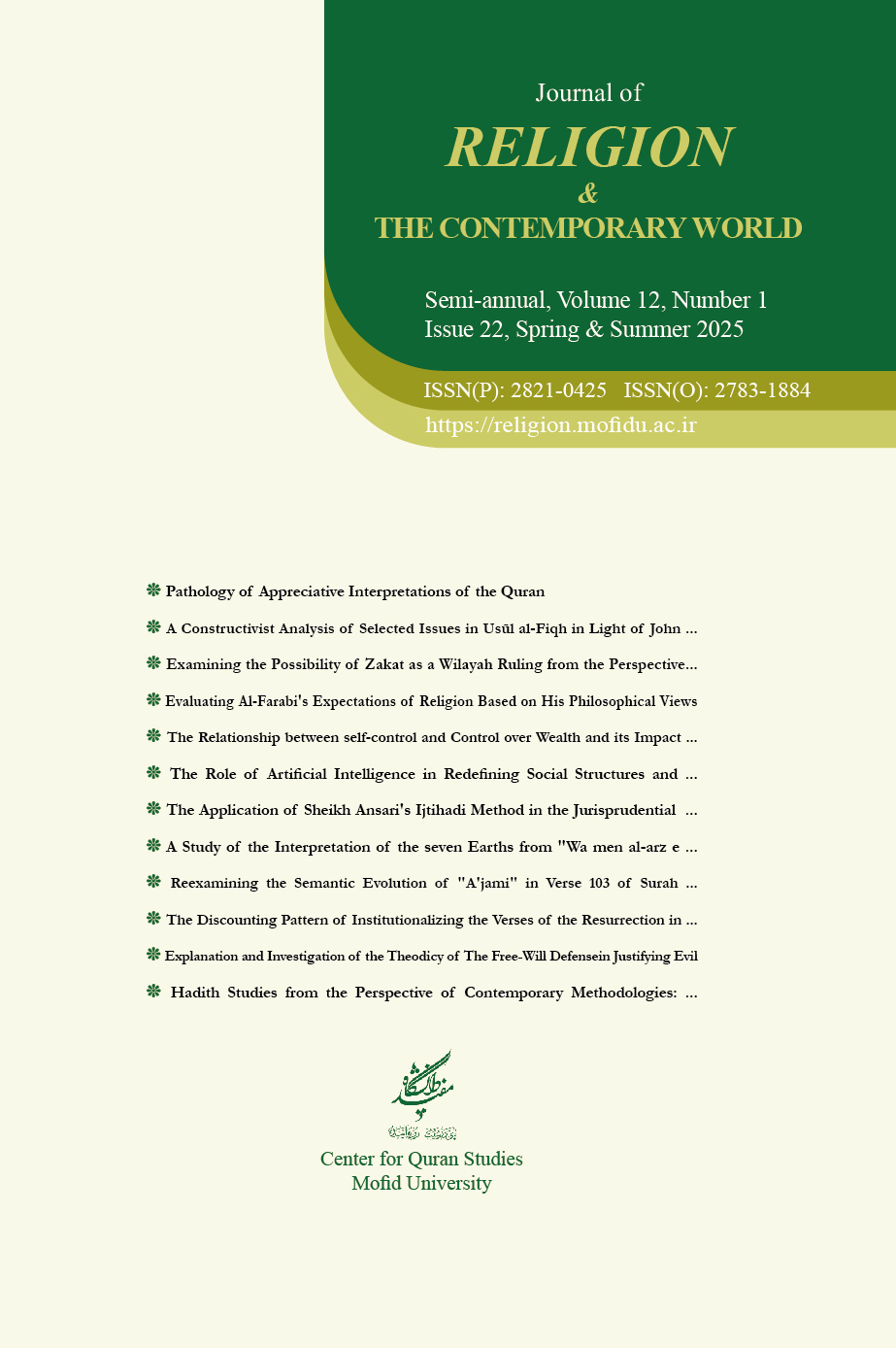
Journal of Religion and the Contemporary World

Journal of Religion and the Contemporary World

The relationship between self-control and control over wealth and its impact on new jurisprudential issues

Document Type : Original Article

Author
PhD student in Jurisprudence and Fundamentals of Islamic Law, Department of Theology, Mofid University, Qom, Iran.
Abstract
**Abstract**

The principle of *Taslit*, as one of the fundamental jurisprudential maxims, refers to the right of disposal and dominion of a person over their property. However, the important question that arises is whether the scope of this principle can be extended to include a person’s dominion over the self or their own body. That is, can the principle of *Taslit* serve as a basis for legitimizing bodily acts such as organ donation, suicide, or other forms of disposal by an individual over their body? In this research, by examining juristic views and jurisprudential evidence, as well as by critiquing arguments such as analogical reasoning of priority, the practice of rational people, and transmitted proofs, it becomes clear that the principle of *Taslit* exclusively refers to property and does not provide sufficient grounds to establish a person’s dominion over the self. Ultimately, the conclusion is reached that although others are not permitted to interfere with a person’s life and body without permission, this does not amount to full sovereignty of the individual over the self. On this basis, it is necessary that contemporary jurisprudential issues related to life and the body, including organ donation, be studied with independent arguments and their own specific principles, and they cannot be addressed merely through an extension of the principle of *Taslit*.
Keywords

Subjects


Bibliography
The Holy Qurʾān.
Dargāhī, Mahdī. “Analysis of the Realm and Domain of the ‘Rule of Authority’ Regarding the Human’s Authority over His Body Organs.”  Journal of Fiqh and Uṣūl 48, no. 2 (Summer 2016): 45–64. [In Persian]
Ḥusaynī Sīstānī, Sayyid ʿAlī. Qaʿidat lā Ḍarar wa lā Ḍirār. Qum: Maktab Āyat Allāh al-Sīstānī, 1993. [In Arabic]
Kashshī, Abū ʿAmr Muḥammad ibn ʿUmar ibn ʿAbd al-ʿAzīz. Rijāl al-Kashshī. Mashhad: Muʾassasat Nashr Dānishgāh-i Mashhad, 1961. [In Arabic]
Khurramābādī, Sayyid Ḥasan. Kitāb al-Bayʿ. Qum: Muʾassasat Tanẓīm wa Nashr Āthār al-Imām al-Khumaynī, 1997. [In Arabic]
Kulaynī, Muḥammad ibn Yaʿqūb. Al-Kāfī. Qum: Dār al-Ḥadīth lil-Ṭibāʿah wa al-Nashr, 2008. [In Arabic]
Kulaynī, Muḥammad ibn Yaʿqūb. Al-Kāfī. Tehran: Dār al-Kutub al-Islāmīyah, 1986. [In Arabic]
Muʾmin Qummī, Muḥammad. Kalimāt al-Sadīdah fī Masāʾil al-Jadīdah. Qum: Muʾassasat Nashr-i Islāmī, 1994. [In Arabic]
Muntaẓirī, Ḥusayn ʿAlī. Kitāb al-Zakāh. Qum: Majmaʿ al-Fikr al-Islāmī, 1992. [In Arabic]
Mūsawī al-Khūʾī, Sayyid Abū al-Qāsim. Mawsūʿat al-Imām al-Khūʾī. Qum: Muʾassasat Iḥyāʾ Āthār al-Imām al-Khūʾī, 1997. [In Arabic]
Najafī, Muḥammad Ḥasan. Jawāhir al-Kalām fī Sharḥ Sharāʾiʿ al-Islām. Beirut: Dār Iḥyāʾ al-Turāth al-ʿArabī, [n.d.]. [In Arabic]
Najāshī, Abū al-Ḥasan Aḥmad ibn ʿAlī. Rijāl al-Najāshī. Qum: Dār al-Fikr, 1986. [In Arabic]
Subḥānī, Jaʿfar. Taḥdhīb al-Uṣūl. Qum: Dār al-Fikr, 1994. [In Arabic]
Send comment about this article
Enter Name.
Enter a valid email address.
Enter a vaid affiliation.
Enter comments (At leaset 10 words)
CAPTCHA Image
Enter Security Code Correctly.